Snowy and the Singularity
Confused by AI, Crypto & Robots? You Came to the Right Place.
Snowy breaks it down in plain English —
five minutes, no textbook required.
If words like Artificial Intelligence, blockchain, crypto, robotics, and the Economic Singularity sometimes sound like people are speaking another language, you're not alone.
The technology is moving incredibly fast, but understanding the basic ideas doesn't have to be difficult. In fact, once you separate the pieces and look at them one at a time, they make a lot more sense.
So let's start with the biggest one.

What Is Artificial Intelligence?
Artificial Intelligence isn't simply a giant computer filled with millions of stored answers. A modern AI model is trained using enormous amounts of information. During that training, it learns patterns, relationships, language, concepts, and connections.
Think about a dental hygienist. She doesn't walk into an exam room and reread every textbook she ever studied before looking at a patient's mouth. Her education and experience have taught her relationships. She recognizes how things such as inflammation, bleeding, calculus, pocket depth, X-rays and a patient's history can relate to one another. She uses those relationships to understand a new situation.
AI works very differently from a human brain, but that analogy helps explain the basic idea. Instead of storing a ready-made answer for every possible question, an AI model learns an enormous mathematical map of relationships. When you ask it something new, it uses those learned relationships to construct a response.
That's also why AI can do more than repeat information. Depending on the system and the tools available to it, AI can analyze, compare, reason through problems, plan, create, and draw useful conclusions from information it has been given.
But AI isn't magic. It can misunderstand something. It can make mistakes. And being able to reason with information does not mean that an AI is a conscious human being.
It is a new kind of tool — and an extraordinarily powerful one.

Now Add Blockchain
AI gives computers an increasingly powerful ability to work with information and intelligence.
Blockchain adds something different: a way for people and computers to record and verify digital ownership, assets and transactions across a network.
A simple way to think about it is this:
AI can help understand what you want to do.
Blockchain can help provide the digital rails on which certain things can be owned, verified and transacted.
Cryptocurrency is one application of blockchain, but blockchain technology is broader than simply buying and selling coins. It can be used to create records, represent digital assets and allow transactions between participants without requiring one central database to be the sole keeper of the record.
Put AI and blockchain together, and intelligent software can begin interacting with a digital economy.
That's part of the idea behind DeFAI — decentralized finance combined with artificial intelligence — and it's one of the ideas behind Snowy.
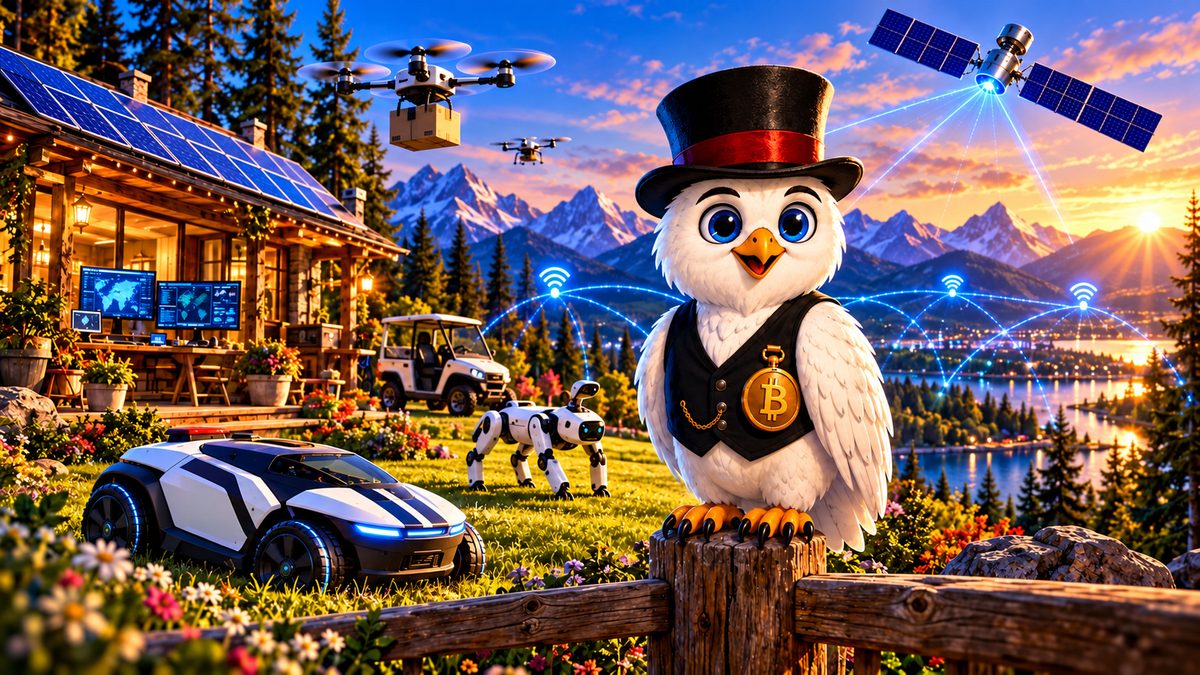
Now Give Intelligence a Way to Act
This is where robotics enters the picture.
AI can understand information and make decisions, but software normally lives inside computers. Robotics gives software a way to interact with the physical world.
And that doesn't necessarily mean a science-fiction humanoid robot walking around your house.
It might be a warehouse robot moving inventory. A drone inspecting equipment. An autonomous vehicle. A machine assisting a farmer. Or something as ordinary as a robotic lawn mower quietly cutting the grass.
Snowy even has one at the Nest.
The important idea is that machines are becoming increasingly capable of sensing their surroundings, navigating, performing tasks and responding to information with less constant human control.
Then add another piece: connectivity.
Satellites, terrestrial networks and other communications systems are extending digital connectivity across more of the planet. Navigation technologies and sensors can help machines understand where they are, while communications networks allow information to travel between devices and services.
Now intelligence doesn't necessarily have to stay behind a desk.
It can begin interacting with the world around us.
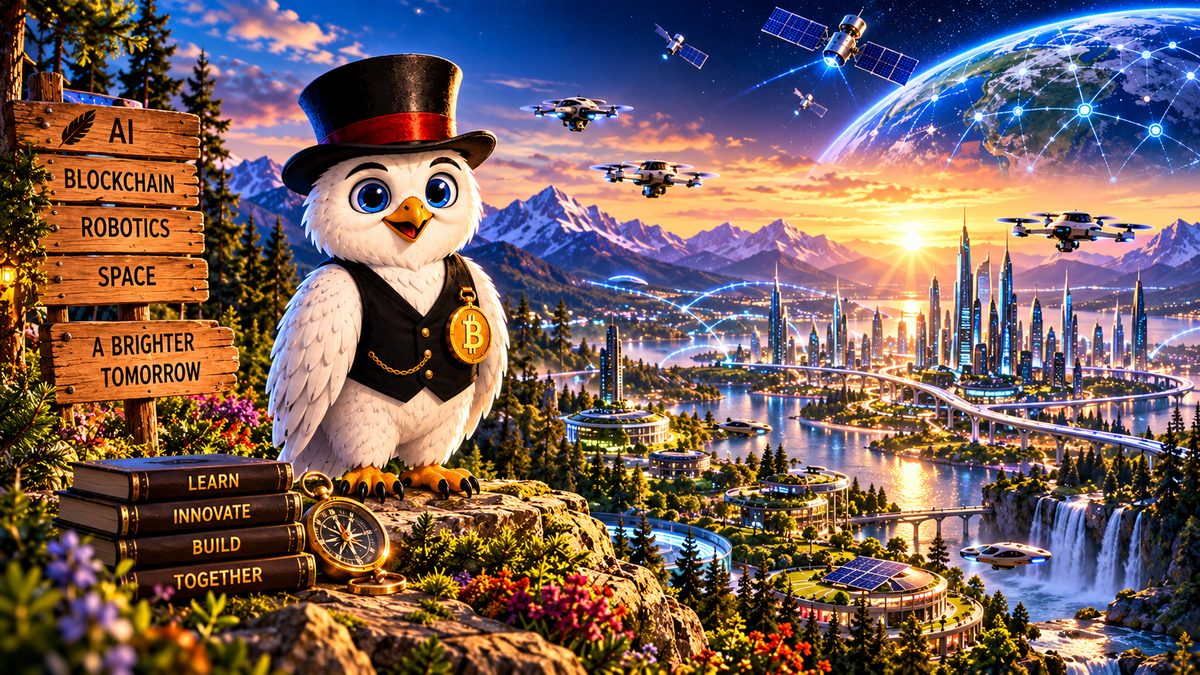
Artwork created with Badger's (ChatGPT) image generation.
Now Put the Pieces Together
This is where things become particularly interesting.
We have:
AI — Intelligence
The ability to understand information, reason, plan and create.
Blockchain — Digital Ownership & Economic Rails
The ability to record and verify certain digital assets and transactions across networks.
Robotics — Physical Action
Machines capable of performing work in the physical world.
Connectivity — Communication
Networks connecting people, computers and machines across enormous distances.
Each of these technologies is important by itself.
But imagine what can happen as they increasingly work together.
An intelligent system could understand a request, communicate with other software, use digital infrastructure to perform an authorized transaction, send instructions to a machine somewhere in the physical world, receive information about what happened, and report the result back to a human.
That convergence is part of a much larger discussion about how technology may change productivity, economics and everyday life.
Investor and entrepreneur Raoul Pal and Real Vision have discussed this broader technological and economic transformation under the idea of the Economic Singularity. Their work helped inspire our four-part educational series and encouraged us to look at these technologies not as isolated inventions, but as technologies developing at the same time and increasingly interacting with one another.
Nobody knows precisely how that future will unfold.
But many of the individual pieces are no longer science fiction.
They're already here.

So… Where Does Snowy Fit In?
Snowy is our attempt to make some of this technology useful without requiring you to become a computer programmer.
Instead of learning commands, APIs and complicated interfaces, you can simply talk to Snowy.
You speak.
AI helps Snowy understand.
Snowy determines which available tool can help.
The tool performs its job.
Snowy explains the result.
And when your authorization is required, you remain the person who gives it.
Snowy isn't a magic owl who knows everything.
He's a friendly way of putting AI, voice, software tools, information services and blockchain connectivity behind a conversational interface that ordinary people can understand.
That's an important distinction.
Snowy can help prepare the flight. You remain the pilot.
And that's really the point of this entire page.
You don't need to become an AI engineer, blockchain developer or robotics expert to participate in what's happening.
You just need to understand enough to ask questions.
If some of this didn't make sense five minutes ago, that's exactly why you're here.
Ready to Get Your Snowy Today?
Click Here
Imagine a personal Snowy on your phone whenever you need him.
Want to Go Deeper?
Watch our four-part Economic Singularity series
These short videos walk through the same journey visually:
Artificial Intelligence → Blockchain → Robotics & Connectivity → The Economic Singularity
Our Economic Singularity series was inspired in part by the work and public discussions of Raoul Pal and Real Vision. Credit belongs to the original creators for their ideas and research; Snowy's series is our own plain-English educational interpretation.
Head over to YouTube and check out my Singularity Series, Click here